

The Week Gold Wouldn’t Leave the Headlines, and Why That Matters Far Beyond Gold
Gold has been everywhere this week.
Not just in the price charts, which seem to reset back to “normal” every few months, but in company results, dealmaking, exploration announcements, and investor conversations that stretch far beyond bullion itself.
Even Crypto has found real gold: If you can’t beat it (or even be it), just buy it! Tether is now supposedly the largest private buyer of gold, and apparently, its current holding of physical gold is significantly higher than most countries!
For years, Bitcoin strutted around as “digital gold,” promising to outshine the real thing. The crypto faithful told us the old yellow metal was obsolete, a relic of the past. Then reality intervened: volatility, regulation, blown-up exchanges, and far too many “innovations” ending in court dates.
And now? The punchline writes itself. The biggest players in crypto are buying actual gold, and lots of it, to back their tokens, stabilise reserves, and borrow a bit of credibility from the very asset they once claimed to replace. Tokenised gold, gold-backed stablecoins, vaults full of bullion… suddenly the original store of value looks a lot less outdated.
So crypto’s evolution is simple: When “digital gold” didn’t quite behave like gold, the industry did the sensible thing, it turned around and bought the real stuff. The halo effect of gold has gone digital.
Sibanye-Stillwater reminded the market of what leveraged gold profitability looks like when discipline meets a rising price environment. Montage doubled down on Côte d’Ivoire, confirming that serious capital is still willing to chase long-life, high-quality assets. And quietly, beneath the noise, early-stage projects in West Africa started flashing signals that usually get ignored… until they don’t.
This all, of course, happened whilst Mali’s government forced Barrick into a no-win situation where a pragmatic settlement left a bad taste (and smell) and did nothing to enhance the reputation of Africa as a mining destination.
The halo effect of gold makes everyone greedy.

What struck me was not any single announcement, but the alignment.
Gold momentum at the top end of the market tends to do one thing reliably: it changes risk tolerance further down the chain. When majors generate cash, boards become braver, capital trickles outward, and suddenly projects that looked “too early” start to look timely. The halo effect of gold makes boards and investors braver.
That backdrop matters when thinking about what is unfolding in Côte d’Ivoire right now.
For years, West Africa has been discussed almost exclusively through the lens of orogenic gold, Birimian terranes, shear zones, and repeatable but often modest-scale discoveries. Proven? Yes. Transformational? Less often.
But this week’s news flow hints at something subtly different.
At Duékoué, in western Côte d’Ivoire, Oscillate PLC released sampling results that, on the surface, didn’t look dramatic. No drilling. No resource. Just soil and geophysics. Easy to scroll past.
Technically, this is how Iron-Oxide Copper Gold (IOCG) narratives begin. These systems aren’t flashy early on. They are often blind, buried, or poorly expressed at the surface. Olympic Dam didn’t announce itself politely. Nor did Carajás. They revealed themselves through pattern, persistence, and coincidence across metals.
I’m not suggesting Duékoué is an IOCG discovery. That would be irresponsible. What I am saying is that the right questions are now justified, and that is often the real inflection point.
This matters even more when you place Duékoué next to Odienné.
Awalé Resources’ Odienné project sits along the same deep crustal architecture, where Paleoproterozoic rocks meet the Man Craton. A few years ago, Odienné was a concept. Today, it carries an earn-in from Newmont, a strategic investment from Fortuna, and drilling results that include multi-metal anomalies spanning kilometres and gold intercepts well above economic thresholds.
That progression, from soil, to structure, to endorsement is not theoretical. It has already happened in the same country, using the same geological logic.
Meanwhile, Montage’s consolidation activity elsewhere in Côte d’Ivoire sends a different but equally important signal. When mid-tier producers commit hundreds of millions of dollars to resource-stage assets, they are not just buying ounces. They are underwriting jurisdictional confidence. They are betting that permitting sticks, infrastructure holds, and long-term mining policy remain predictable.
And Côte d’Ivoire has quietly earned that bet. But these types of projects need the halo effect of a rising gold market, both for investor interest as well as for actual funding. Its mining sector delivers longevity. This is where gold’s role changes.
Gold is no longer just the prize; it is the enabler.
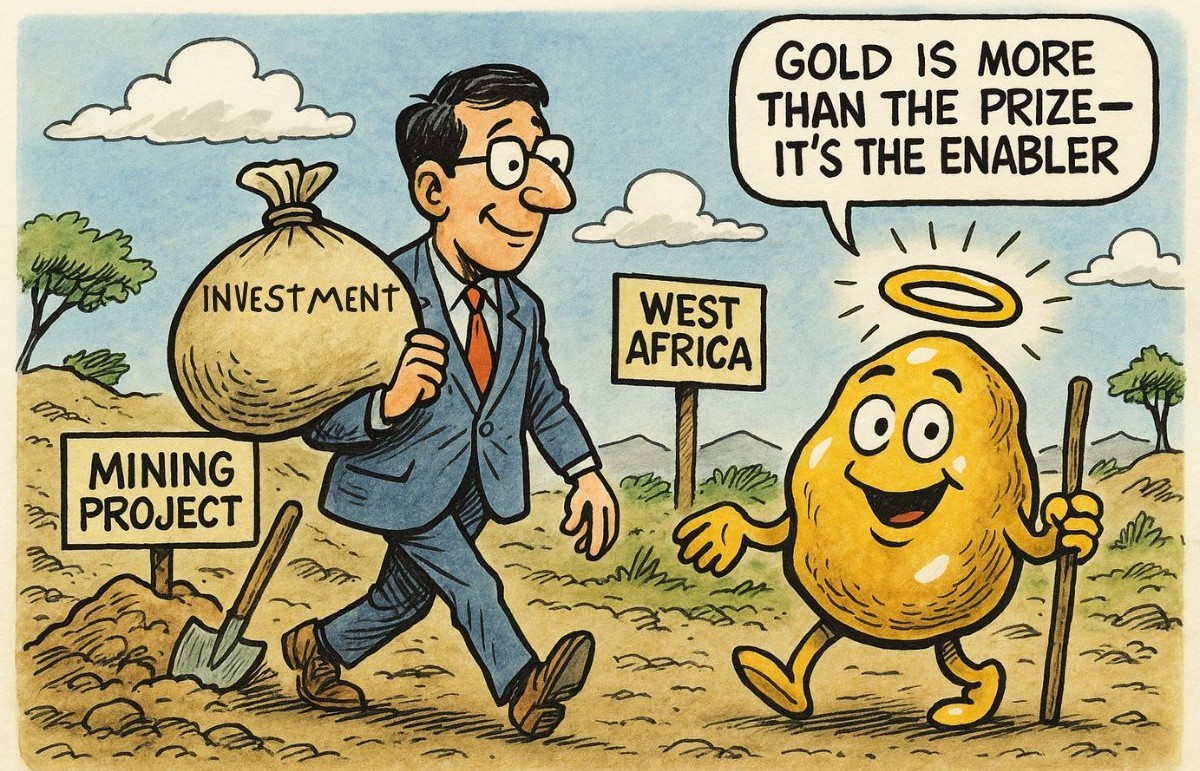
High gold prices underpin cash flow. Cash flow underwrites exploration. Exploration gives oxygen to deeper systems that might also host copper and molybdenum; metals that matter enormously to electrification, defence, and industrial resilience. That triad, gold for stability, copper for growth, molybdenum for strategic relevance, is why IOCG systems attract patient capital once confidence sets in.
Which brings us back to Duékoué.
Oscillate is tiny. Sub-£2 million market capitalisation kind of tiny. That cuts both ways. Most projects at this stage disappear quietly. Some, however, don’t. They either mature… or get acquired when their geological logic becomes too interesting to ignore.
The interesting thing here is not hype, but precedent. Odienné shows the pathway. Montage shows the capital appetite. Sibanye shows the price environment. And Duékoué shows just enough technical alignment to justify the next step: trenching, structural confirmation, disciplined escalation, not speculation.
This is where ZBS always slows down the conversation.
Because moments like this create two equal and opposite risks: missing a genuine shift by being too cautious or inventing a story because the macro mood feels good. After over 40 years in the gold industry, it is hard not to smile at all the ‘but this time it is different’ narratives.
The right response lies in patience and scrutiny. Do follow-up programmes confirm structure? Do anomalies persist when exposed? Does the geochemistry hold under tighter sampling? Hard questions. Necessary ones.
But this much is clear: gold’s visibility this week is not accidental. It reflects capital searching for reliability in an uncertain world. And when that capital starts looking outward, toward frontier systems and deeper geological ideas, it is worth paying attention.
Not because every project will succeed. Most won’t.
But because occasionally, quietly, worlds change precisely when everyone thinks nothing much is happening. So, while Gold may have taken the headlines this week, what it may be quietly doing is reopening the door to something much bigger.
As always, ZBS will continue asking questions. Disagree, challenge the geology (remember I was playing Bridge in the cafeteria during geology lectures!), add data we’ve missed…become a part of the community!
~ Z. B. S

































Latest Posts