

The Stripped Down Edition
Editors Note: In lieu of the upcoming London Indaba, my wife Tracey and I have been traveling. As a result, this article was prepped and ready to go in advance, a feat I am not often capable of.
Scheduled to post tomorrow morning in South African time, I could not in good conscience allow the article to be released as is in light of recent events. I made a promise when I started this newsletter, that it would not be some parroted version of what is easily accessible information. Instead, I vowed to share my ‘Zero Bull Sht’ opinions, thoughts, and insights on the events that directly impact our industry, and more importantly, the future of our industry and the leaders we leave it to. (Much to my wife’s horror. If you’ve heard my unfiltered takes, you’ll understand why.)
I thought of ZBS as a manual, a real-time “how to”, or perhaps, a “how not to” for those who come after me.
I cannot do that by repeating stats and data that we all have access to, and for the most part, that was what this newsletter would have predominantly focused on, instead of what I might have actually wanted to diplomatically address…
“The Cost Of War- If Critical Mining were a Currency”. ‘
So, What Is The Cost?
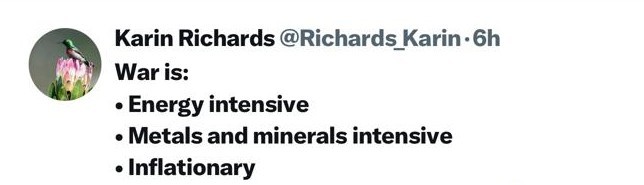
Let’s drop the romanticism: wars are no longer fought with just boots on the ground and barrels pointed outward. They’re engineered, layered with satellites, sensors, hypersonic missiles, and drones. And all of it runs on metals. Africa, for all its political chaos and infrastructure woes, is sitting on one of the world’s most consequential arsenals.
Not of weapons, but of elements: manganese, platinum, vanadium, chromium, lithium minerals so strategic, they might as well be flags planted in the battlefield. The world is rearming, not just militarily, but industrially. Copper, for instance, isn’t just for wiring your house, or critical for the energy transition; it now also underpins Western artillery and is baked into every precision strike system.
Whilst the ICA does not appear to have published any specific figures for military copper demands, (which would have been a great stat to drive my point), the estimated global copper demand in 2023 was 26 Million tonnes. Annual military demand for copper alone is estimated at around ~500,000 tonnes, which would represent roughly 1.9% of the total demand, which whilst just an estimate, it is still a plausible figure for military and defense-related usage. That’s not theory, it’s a minerals arms race, driving copper demand in the West to an estimated 10–15% annually (partly due to Ukraine war, NATO restocking, and U.S. munitions production).
South Africa holds the world’s largest reserves of manganese (80%) and PGMs (80%), along with 70% of chromium reserves. However, it accounts for only 30-45% of global production in these minerals due to underinvestment. Mining contributes 7.5% to GDP and 30-35% of exports, yet most minerals are shipped raw, only 10% are processed domestically, forfeiting billions in value-added revenue.
Exporting un-beneficiated ore may be good economics, but it certainly is poor strategy. Our pit to port strategy may have served us well, but clearly, it served China even better.
While Europe and the US scramble to de-risk from China’s chokehold on mineral processing, South Africa keeps handing over its leverage. The leverage to be a strategic partner to the world where our products finally gets consumed. Our ports are clogged, our railways in disrepair, and our energy grid barely limping. But beneath our feet? A literal war chest. And instead of fortifying it, we keep opening the gates.

Take manganese:
Manganese Metal Company (Pty) Ltd
(MMC) is the only producer of high-purity Electro-Manganese Metal (EMM) outside China, churning out ~28,000 tonnes per year. They’re pushing into high-purity sulphate monohydrate, key for batteries, by 2026. This is a step in the right direction, but still a rare exception. This would position MMC as a key Non-Chinese supplier for the EV battery market, where China currently controls around ~95% of global HPMSM production.
For the purposes of full disclosure, I am a co-owner of MMC and the Chairman of the board.
Mintek, backed by R250 million in funding, is reviving research into ferroalloy production and launching rare-earth processing. These are green shoots, but they won’t flourish in infertile ground. All this to say that the reality of the situation presently is that MMC is a rare success story in Non-Chinese manganese refining, but scaling battery-grade production will require significant investment. Mintek’s initiatives are promising, but without solving energy and infrastructure bottlenecks, impact will remain limited.
South Africa still exports around ~90% of its manganese as ore, missing out on higher-value markets.
Processing and beneficiation, is often talked about like a developmental luxury. It’s not. It’s a necessity.
In war, be it for the energy transition, or for the devastating destruction of mankind, you want to own the supply, and you want to control the whole value chain. An exceptionally crude statement to make at such a catastrophic time in our world. But this makes me question, would a better and more strategic manner of beneficiation and processing of our countries Critical Minerals decrease the ability for war-based exploitation of resources?
Would this be the mining and refinery worlds partial solution to securing a modicum of control when supplying products as a supplier, not as a weaponry or armament?

South Africa could become indispensable, a neutral power whose value isn’t measured in GDP figures but in global security calculations. Instead, we risk being sidelined, rich in minerals but poor in power and influence.
Yet beneficiation is no silver bullet. Processing is expensive. Energy accounts for up to 40% of manganese refining costs. The infrastructure is broken. We have to truck ore over 940km’s from the mine to our plant. Skilled tech and capital are thin on the ground. Despite continued public pronouncements, South Africa’s Government has almost no financial support available for this re-entry into midstream value adding. As Private sector players, we are truly on our own against the global dominant players like China, who continues to dominate the downstream value chain.
So, the question is: Can beneficiation really relieve the pressure, and shift South Africa from mineral miners (or perhaps minors?) to mineral power? Or are we too late in a game already rigged?
We need stable, affordable electricity. We need functional logistics. We need bold partnerships, public and private, local and global. And yes, we need policies that prioritize downstream value without choking investment, or thinking we can legislate for it by forcing mining companies into something they have no reason to be in. If South Africa truly wants to matter in a fragmented, high-stakes world, it must stop selling its future by the tonne. Start refining. Start leveraging. Start seeing minerals not only as exports, but as influence.
Because in this century, the side that controls the minerals doesn’t just win the war. They define it.
– Z.B.S




































Latest Posts