

Why South Africa is Losing More Than Just Mines
There’s a comforting storyline currently making the rounds in our industry. It suggests that the exit of major mining houses from South Africa is simply part of a “global portfolio optimization” or “smart capital allocation”.
The narrative is clean: capital goes where returns are highest, companies evolve, and South Africa must simply accept its place in the cycle.
This conversation has obviously been triggered by recent events, like the Anglo de-merger of its platinum division. But this is a very long storyline that has been evolving since the advent of our democracy thirty-two years ago. And while that narrative isn’t necessarily wrong, I don’t think that it’s complete either.
What we are losing is not just the ownership of assets. We are losing institutional capacity, that invisible architecture that made South Africa one of the most sophisticated mining ecosystems in the world. Unlike shafts and plants, that capacity doesn’t just rebuild itself when the cycle turns.
We are currently mining yesterday’s discoveries.
South Africa didn’t stop finding minerals because our geology became less generous; we stopped because we stopped looking properly. The great mining houses once funded exploration as a systemic necessity. Today, we have almost no junior activity, our geological data is dated, and access to it is, frankly, pathetic.
Regulatory friction continues to drive explorers elsewhere. To fix this, we have to:
- Incentivize exploration through flow-through share schemes or direct incentives.
- Open up geological data. We have a treasure trove of data sitting in the filing cabinets of retiring geologists and dispersed across the world.
- Crowd in risk capital. If South Africans love gambling as much as they seem to, surely we can open our minds to high-risk investment with real potential for return.
I am deeply worried about the lack of R&D. We once led the world in deep-level mining innovation out of necessity. Today, we are followers, importing solutions for almost everything. The issue isn’t the technology itself; it’s the loss of the problem-solving capability that comes with a healthy ecosystem.
We need to return to industry-funded R&D centers and align our universities with key industry components. Our government shrugging and saying they “don’t have money” is a recipe for stagnation. The rest of the world is incentivizing innovation; we cannot afford not to.
Somebody recently referred to our skills decline as a slow leak. When I joined the industry forty-five years ago, I entered a privileged, structured training environment. That simply doesn’t exist anymore. We’ve seen a decline in structured training, from practical work experience for students to the conversion of qualifications into professional registrations.
I’ll admit, I feel a sense of shame because I was part of dismantling some of these platforms as a cost-cutting exercise decades ago.
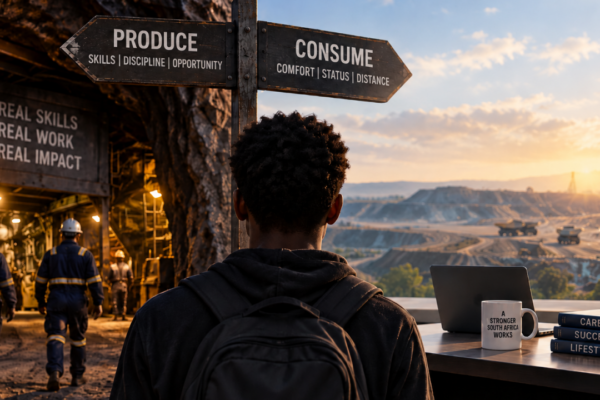
We viewed training centers as cost centers and now, thirty years later, we are paying the price. Mentorship is vital, but it’s not the be-all and end-all. I mentor young people facing a world very different from the one I operated in. The ultimate solution is to capacitate young people with real skills and then allow them to solve real-world problems in real-time.
The mining house structure of the 1980s was designed for long-term capital. Without it, none of our great deep-level mines would have been built. It handled complex geology and managed portfolio risk in a way modern capital simply doesn’t. Today, viable resources sit stranded because of a lack of funding. We need long-term, blended capital models to replace what was lost with the demise of the traditional mining house.
Finally, we must address the “quiet loss”: knowledge, data, and IP.
When majors exit, they often take or abandon geological data. Institutional memory is something you only realize you’ve lost once it’s gone. We need national data platforms. The state should collate this data and make it available for research. Imagine how many PhDs are still hidden within 140 years of Witwatersrand gold basin data?
South Africa hasn’t run out of minerals. We are, however, at risk of running out of the capability to turn those minerals into mines. Our challenge is not to bring back the past, but to rebuild a system that is fit for the future.
What do you think is the most critical and “invisible” asset we need to reclaim to ensure the future of South African mining? Let’s discuss in the comments.
~ Z.B.S








































Latest Posts