
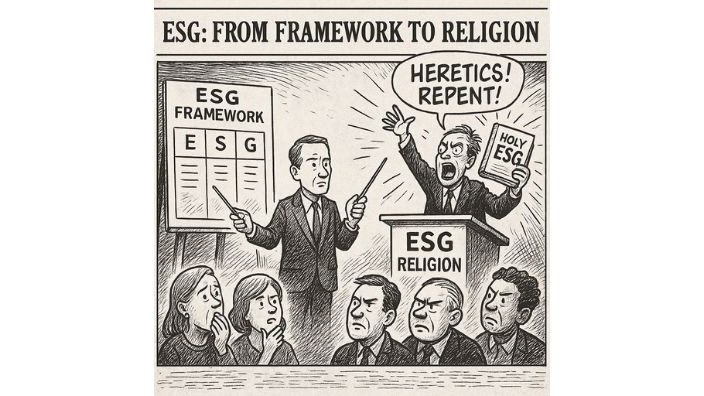
When ESG first emerged in the early 2000s, it was not a political cudgel or a moral theatre piece.
It started inside institutional investment as a simple, practical recognition that non-financial risks (environment, social externalities, and governance failures) ultimately end up as financial risks. Investors sought a way to value what balance sheets were not yet capturing.
That made sense.
But somewhere in the 2010s and especially post-2020, ESG exploded into mainstream corporate, public sector, NGO, and political discourse… and the world lost the plot a bit.
We bundled E, S, and G together because it was administratively convenient. One acronym. One meta-scorecard. One language. The problem is that the three are not compatible time horizons, nor compatible trade-offs.
E = decades-long climate, energy transition, irreversible planetary systems
S = near-term daily social conflict, jobs, inclusion, fairness, labour instability
G = institutional design, accountability, incentives, and decision quality
Global geopolitics is now pushing back fiercely.
US elections, European energy security anxiety, the return of industrial policy, supply chains risks, food insecurity, China hedging, and geopolitical realignment are all creating stronger national interest (some would say selfish) narratives than “global sustainability unity.”
And suddenly ESG is being accused of being elitist, anti-growth, anti-fossil fuels, anti-nationalism, anti-jobs, and even “woke.”
We are seeing rollbacks everywhere:
- funds quietly removing aggressive ESG filters
- multinationals downgrading climate commitments
- mining & heavy industry re-arguing timelines
- tech firms slashing DEI budgets overnight
- fossil fuel majors reporting record profits and record lobbying successes
ESG was never meant to be an ideology. It was meant to be risk management. But it failed dismally as a risk management tool. It got so diluted that it made zero impact on our climate footprint, we missed the obvious risks embedded in outsourcing all manufacturing to China, and we allowed modern-day Monopolists to write the rules the world must play by.
The Greenwashing Era Should End
Far too much corporate ESG is gimmick-level cosmetic signalling:
- Retailers bragging about removing chocolates from the till line and calling it “Social impact”
- ESG “Points” products sold by consultants like air miles
- Everyone claiming net-zero by 2030 with zero Capex committed
- Companies publishing 180-page ESG reports with no 1-page cash flow sensitivity
- AI ESG dashboards are generating “impact indices” with no audited evidence
- Sustainability Departments and newly minted CSOs fool nobody
This is ESG as optics. PR insurance. Theatre.
What will (or at least should) survive?
The serious version:
- aligns with materiality
- links measurement to capital allocation
- integrates ESG into governance, treasury, procurement, and operations
- is verifiable and auditable
- builds resilience, not flashy reports
Will ESG Survive?
ESG will survive if ESG grows up. If it remains as just branding and slogans, it will collapse.
If it becomes a tool for real decision-making and long-term risk management, it may just become what it was originally intended to be. South Africa has an advantage. We KNOW real risk. We have lived the consequences of ignoring social breakdown, governance failure, and environmental fragility.
Our leadership role is not to preach ESG; our role is to professionalise it. To live it.
From theatre to capability.
From marketing to measurement.
From reporting to resilient value creation.
And that is how ESG earns the right to exist deep into the future.
I would love to hear your thoughts and/or rebuttals on this topic. Not as a trend, but as a matter of importance.
~ Z. B. S























































Latest Posts