

Why South Africa’s 3–5% Dream Is Bullsh*t Until We Unblock The Plumbing
A few months ago, in this very newsletter (Edition #7: Stop Digging and Start Building), I wrote about a possible roadmap to get South Africa to 3–5% GDP growth. I laid out what we’d need: investment, beneficiation, infrastructure, skills, and above all, political will.
But after watching the national conversation unfold, from politicians to boardrooms…I’m convinced we need to revisit this, with a harder lens. Because what I’m hearing isn’t a roadmap. It’s a mantra. And mantras won’t create growth.
Everyone’s chanting: “We need 3–5% growth.”
But the truth is: we won’t get there until we unblock the blockages in the pipes.
Let’s get blunt: South Africa’s growth problem isn’t about ambition. It’s about blockages.
- Energy drag: The OECD estimates loadshedding and energy insecurity have already cut growth by ≈2 percentage points annually. Until Eskom and new energy investment catch up, growth is capped. Loadshedding disappeared, yes, but that has more to do with our energy-intensive industries having shut down, than with us having enough power. Even Eskom admits that you cannot sustain the economy with continued double CPI price increases.
- Transport bottlenecks: According to PwC’s SA Mine 2025, Transnet’s rail and port failures are costing mining exporters R50–60bn a year. That’s money that should be circulating in the economy. The green shoots are there, but Transnet’s balance sheet is on incident away from a national disaster.
- World Bank ceiling: The World Bank calculates that energy and logistics constraints shave off about 3% of GDP every year. Put differently, even if the economy had the potential to grow at 5%, we’re stuck closer to 2% because of infrastructure bottlenecks.
- Investor flight or strike: South Africa now attracts less than 1% of global exploration spend, despite its geological endowment. The Minerals Council calls out policy uncertainty and delays as the key deterrents. South African businesses sit on R1,8 trillion in bank deposits as of July 2025, according to the SA Reserve Bank. Why is it better to sit on cash, rather than to invest in growth? Our high real interest rates attract huge amounts of short-term and overnight money, helping to strengthen the Rand, but let’s not fool ourselves that any of it is actual investments.
- Skills mismatch: Stats SA’s Q2 2025 Labour Force Survey shows youth unemployment above 43%, while the mining and engineering sectors still complain of critical skills shortages. That’s not just a social crisis, it’s an economic handbrake.
- The beneficiation myth: The government’s 2025 Critical Minerals Strategy promises downstream processing, but even its own analysis admits high energy costs and weak infrastructure make this almost impossible without systemic fixes.
In my earlier roadmap edition, I tried to be constructive: “here’s what’s possible if we take bold action.”
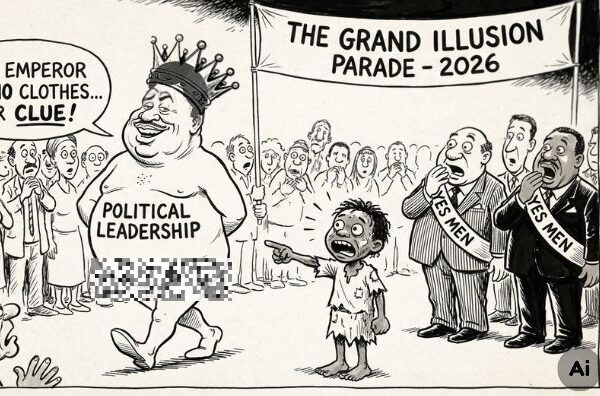
This edition is different. It’s about calling out the illusion. Saying “3–5% growth” in speeches, policy documents, or press releases is not a strategy. It’s wishful thinking. And in a Zero Bullsh*t world, wishful thinking is dangerous because it creates the false impression that progress is being made.
Now here’s the part some will find uncomfortable:
South Africa doesn’t have a growth problem. It has a blockage problem.
Until energy, rail, ports, skills, and policy certainty are unblocked, chasing 3–5% growth is like trying to sprint with your shoelaces tied together. You might move forward, but you’ll fall flat on your face before long.
So, to government, CEOs, and even my fellow “old toppies” in mining and industry: stop hiding behind the slogan. Stop pretending growth is a number you can talk or announce into existence.
Growth only comes when we unblock the plumbing pipes and create an enabling environment. If business leaders believed that it was happening, they would start investing in the growth opportunities in front of them, thereby making it happen.
The uncomfortable truth is that South Africa could hit 3–5% GDP growth tomorrow if the basics were fixed. The fact that we aren’t fixing them tells us everything about our politics, our priorities, and, frankly, our leadership.
This is not cynicism. It’s an urgency.
We’ve touched on this before in ZBS. But today, the gap between what’s promised and what’s real is wider than ever. And if we don’t strip the bullsh*t away, we risk normalizing talking and announcing mediocrity as if it were progress.
So let’s stop repeating the dream and start unblocking the plumbing. Anyone who has ever had to do that, unblocking the plumbing, knows it is messy and unglamorous, but absolutely necessary if you don’t want to be stuck in an even worse situation. Hand me a ‘monkey wrench’!
I now hand it over to you: Do you believe South Africa can realistically hit 3–5% growth in the next five years, or is that number itself part of the illusion?
As always, let’s discuss it in the comments. Like, share, and subscribe to stay ahead of the bullsh*t and at the forefront of change.
– Z. B. S





























Latest Posts